Kuleshov Effect Montage Theory Examples: How Juxtaposition Creates Meaning
Film editing is often described as invisible craftsmanship, but its most powerful effects depend on images being seen together. A shot can suggest one thing in isolation and something entirely different when placed beside another. This principle sits at the heart of the Kuleshov effect montage theory examples that continue to shape how editors think about meaning, emotion, and audience attention.
Editing does not merely join scenes. It creates relationships. A face, an object, a gesture, and a reaction become a sentence when arranged in the right order. By studying how the Kuleshov effect and Sergei Eisenstein’s montage theory operate, we can see why juxtaposition is one of the central tools of cinematic storytelling.
What the Kuleshov effect demonstrates
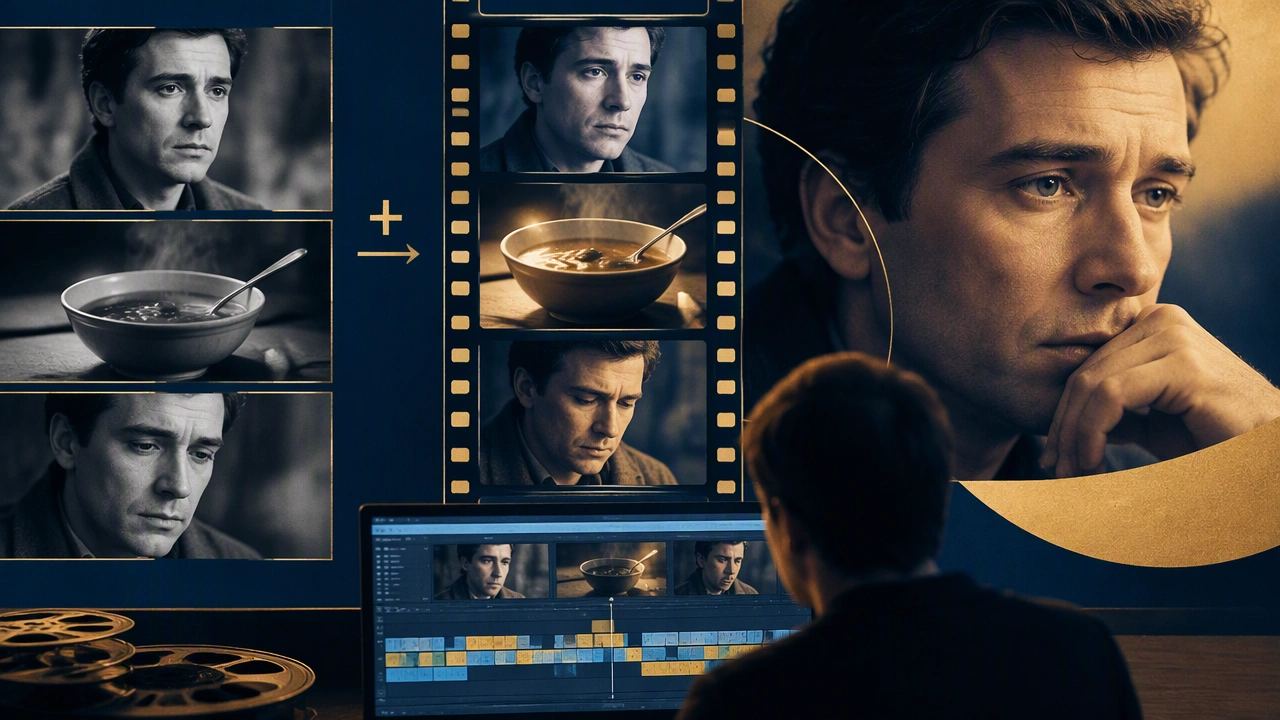
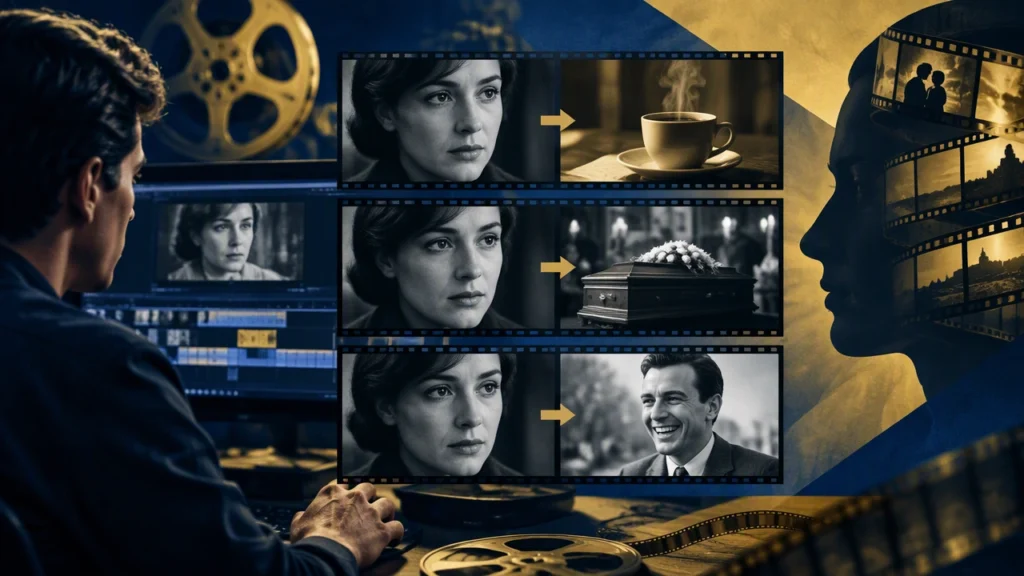
The Kuleshov effect is named after filmmaker and theorist Lev Kuleshov, who explored how viewers interpret a neutral expression according to the image shown next to it. In the familiar demonstration, the same shot of a face is paired with different images: food, a coffin, or a child. Audiences reportedly read the expression as hunger, grief, or tenderness, even though the facial shot never changes.
The point is not that viewers are easily fooled. It is that meaning arises from the relationship between shots. The face supplies a human point of identification, while the adjacent image supplies context. The viewer completes the connection by inferring an internal state. Editing therefore does not simply present information; it prompts the audience to actively construct it.
This principle explains why reaction shots matter. A character’s glance can redirect the meaning of an entire scene. Held too long, it may suggest suspicion. Cut quickly after a line of dialogue, it may imply discomfort. Placed after an object, it may communicate desire or recognition. The editor controls not only what we see, but what we believe the character sees.
From association to intellectual montage
Sergei Eisenstein expanded the idea of juxtaposition beyond emotional association. For Eisenstein, montage was a method of producing ideas through conflict. Rather than treating shots as interchangeable building blocks, he argued that the collision between images could generate a new concept that neither shot contained by itself.
This approach is often called intellectual montage. Two contrasting images can place social, political, or philosophical questions in the viewer’s mind. A factory mechanism beside a human gesture may suggest dehumanization. A feast beside poverty may produce an argument about inequality. The edit does not state the conclusion outright; it creates the conditions for the viewer to infer it.
Eisenstein’s understanding of montage also included rhythm, scale, and visual contrast. A cut can gain force through a change in direction, texture, lighting, or movement. The impact comes not only from what is depicted, but from how the shots differ. Editing becomes a form of thinking through images.
Kuleshov effect montage theory examples in practice
Several common editing patterns illustrate how juxtaposition works in ordinary scenes:
- Reaction before revelation: Show a character’s shocked face before revealing what caused the shock. The delay creates curiosity and makes the eventual image feel more significant.
- Object and desire: Cut from a character to an object, then back to the character. The return shot invites viewers to read longing, calculation, or recognition into the expression.
- Contrasting environments: Place a scene of comfort beside a scene of hardship. The comparison creates a social or moral meaning without dialogue.
- Action and consequence: Follow an impact with a detail shot, such as a falling object or a closing door. The new image extends the event beyond the physical gesture.
- Sound-image conflict: Pair a calm voice with an image of danger, or violent sound with a quiet image. The mismatch can create irony, tension, or psychological unease.
These examples are not tricks designed to manipulate viewers. They are grammatical choices. Like words in a sentence, shots gain meaning through arrangement, repetition, and contrast.
How editors control meaning through juxtaposition
Editing decisions determine the direction of attention. The order of shots establishes cause and effect, while shot length controls how long an idea is allowed to register. A quick cut can make two images feel causally connected even when they are unrelated. A longer hold can create ambiguity, reflection, or discomfort.
Point of view is another crucial factor. When a character looks off-screen and the next shot reveals an object, viewers naturally assume that the object is what the character sees. This simple continuity of gaze creates spatial and psychological coherence. If the next shot shows something unexpected, the editor can deliberately break that assumption to suggest confusion, deception, or a shift in reality.
Juxtaposition also shapes rhythm. Repeated images can establish a pattern, while a sudden change in scale or location can interrupt it. The interruption may function as a visual accent, signaling a turning point or a new line of thought. Editors often build sequences around these rhythmic contrasts, using silence, movement, and duration as carefully as dialogue.
The audience completes the cut
The most important element in montage is the viewer. Meaning does not reside inside a single frame; it emerges in the space between frames. The audience supplies continuity, motive, and emotional weight by connecting what it sees. This is why an apparently simple cut can carry so much force: it asks the mind to bridge a gap.
Understanding the Kuleshov effect and Eisenstein’s montage theory helps writers, directors, and editors make those gaps intentional. Instead of asking only what a shot contains, they can ask what the shot means beside another. The result is a story shaped not only by events, but by the precise order in which those events are revealed.
Good editing is not hidden because it is empty. It is hidden because its logic is felt. Each cut proposes a relationship, and each relationship invites interpretation. Juxtaposition turns fragments into a story, giving images their emotional force and giving viewers a role in creating the meaning they experience.