Home / Continuity & Story Logic
Continuity Editing 180 Degree Rule Explained: Eyeline Match, Screen Direction, and Clear Film Examples

Film editing is the art of shaping time and space so the audience understands who is where, what they see, and where they are going. Continuity editing 180 degree rule explained is a practical starting point for that understanding. It focuses on preserving a consistent spatial map across shots, using a few clear rules that editors, directors, and cinematographers follow to keep geography readable.
This article breaks down three core ideas: the 180-degree rule, the eyeline match, and screen direction. It shows how each one works, why it matters, and how well-known films use them to guide the viewer without drawing attention to the cuts.
What the 180-degree rule is and why it matters
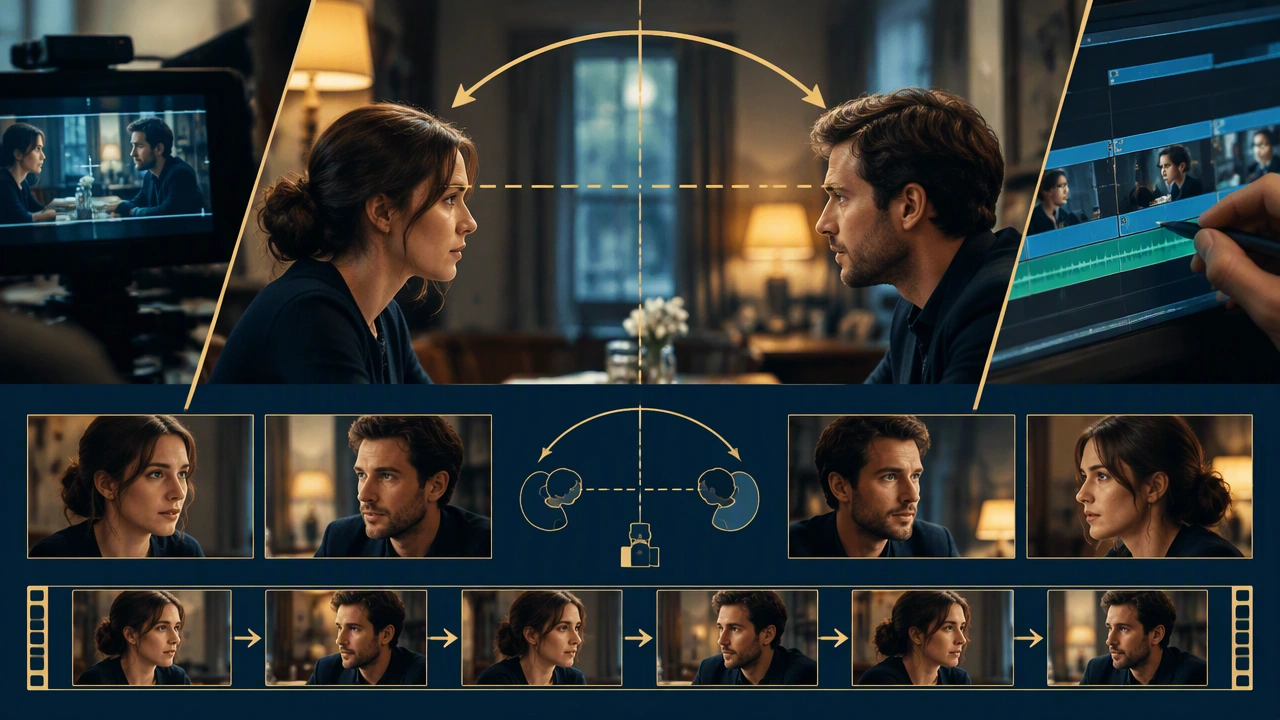
The 180-degree rule states that the camera should stay on one side of an imaginary axis between two subjects or between a subject and a point of interest. As long as the camera remains on that side, left and right stay consistent from shot to shot. If the camera crosses the line, the screen positions flip, and the audience may think characters swapped places or are looking in the wrong direction.
Keeping to one side of the axis preserves a simple spatial contract: Character A is on the left, Character B is on the right, and they face each other. When a cut lands, the viewer does not have to relearn the map of the scene.
The Bourne Ultimatum is often cited for rapid cutting, but many of its handoff scenes still respect the axis. In the Waterloo Station sequence, Bourne watches a contact cross a busy concourse. The camera holds one side of the line between Bourne and the contact, so the back-and-forth cuts remain readable even under pressure. The energy is high, yet the geography stays clear because the axis is consistent.
The Social Network shows the rule in a calmer register. In the deposition rooms, the camera often keeps one side of the line between opposing characters. As the film cuts between testimony and flashback, that spatial consistency helps the audience track who is speaking to whom and where each person sits.
How to break the 180-degree rule on purpose
Breaking the rule can signal disorientation, conflict, or a shift in power. The key is intention. A motivated jump across the axis should support the story beat, not simply happen because coverage was messy.
Jaws uses a deliberate axis shift during the beach questioning scene. As Chief Brody speaks with concerned citizens, the camera crosses the line to heighten the sense of pressure and community conflict. The break is brief and purposeful, and it matches the scene’s emotional turn.
Oldboy and other stylized thrillers sometimes cross the axis during moments of moral confusion or psychological fracture. The effect is unsettling by design. The audience feels the ground shift, which is exactly the point.
A simple rule of thumb for editors: if you must cross the line, give the viewer a small reset. A neutral single, a camera move that shows the new side, or a beat of action that reorients the eye can bridge the jump and keep the scene legible.
Eyeline match: guiding the viewer’s gaze
An eyeline match connects a character’s look to what they see. Shot A shows a character looking off-screen. Shot B shows the object or person from a direction and height that match the eyeline. The cut feels natural because it follows the audience’s expectation: we see a look, then we see what the look is about.
The Silence of the Lambs uses careful eyelines in the cell-block conversations. When Clarice looks slightly up toward Hannibal, the reverse is angled down toward her. The geometry of the eyelines builds tension and keeps the viewer locked into the power dynamic.
Vertigo uses eyelines to knit subjective experience. When Scottie watches Madeleine from a distance, the eyeline matches place us in his perspective and reinforce his obsession. Later, the film’s point-of-view structures echo that pattern to deepen the mystery.
In dialogue, a common setup is slightly off-center eyelines. Characters look just past the lens, not directly into it. This keeps the audience in the scene rather than breaking the fourth wall. The editor trims these shots so the rhythm of glances supports the beat of the conversation.
Screen direction and the line of action
Screen direction is the path a character or vehicle takes across the frame. If someone moves left to right in one shot, the next shot should preserve that direction unless there is a clear reason to change it. This continuity lets the audience infer travel, progress, and geography without extra exposition.
Mad Max: Fury Road is a masterclass in screen direction. The convoy drives one way for most of the film, and the editing protects that vector. When the war rig turns back, the film builds a distinct visual reset so the audience understands the new direction. Reversals feel earned, not accidental.
North by Northwest handles travel and pursuit with crisp directional continuity. Train platforms, chases, and cross-country movement use consistent left-to-right or right-to-left vectors so the viewer always knows where the story is heading.
Putting the pieces together in the cut
These tools work as a system. The 180-degree rule sets the map. Eyeline matches tell the viewer where to look. Screen direction tells the viewer where the story is moving. When all three align, cuts feel invisible, and the audience stays immersed in the scene.
In practice, editors often protect these choices during assembly. They flag any shot that flips screen direction, any eyeline that points the wrong way, and any setup that crosses the axis without a plan. Small fixes early, like swapping a take or adding a neutral single, save hours of confusion later.
There are also graceful exceptions. A motivated axis break can underline a character’s shock. A reversed screen direction can mark a turning point. A mismatched eyeline can suggest deception. The point is that these choices should read as storytelling, not as errors.
Simple checks you can apply today
- Map the axis: Draw an imaginary line between subjects. Keep the camera on one side unless you plan a break.
- Track the look: Make sure each eyeline points to the right target at the right height and direction.
- Lock the vector: Preserve left-to-right or right-to-left movement across shots. If you reverse it, motivate and reset.
- Use neutral singles: A centered, less directional shot can bridge an axis change or a big eyeline shift.
- Test with a fresh eye: Watch the scene with sound off. If geography still reads, your continuity is strong.
Continuity editing is not about rigid rules. It is about clarity. The 180-degree rule, eyeline match, and screen direction give the audience a stable space so they can focus on performance, tension, and meaning. When you honor those principles, your cuts disappear, and the story takes over.